

You will find a range of Continuous Professional Development (CPD) courses designed to enhance your knowledge, skills, and professional practice while supporting your Social Work England registration requirements.
Resources include interactive learning modules, video-based courses, booklets, and a variety of useful learning materials.

The Refreshed
Professional Capabilities Framework
The learning pod reviews the refreshed framework for learning and development in social work practice. It will help you to:
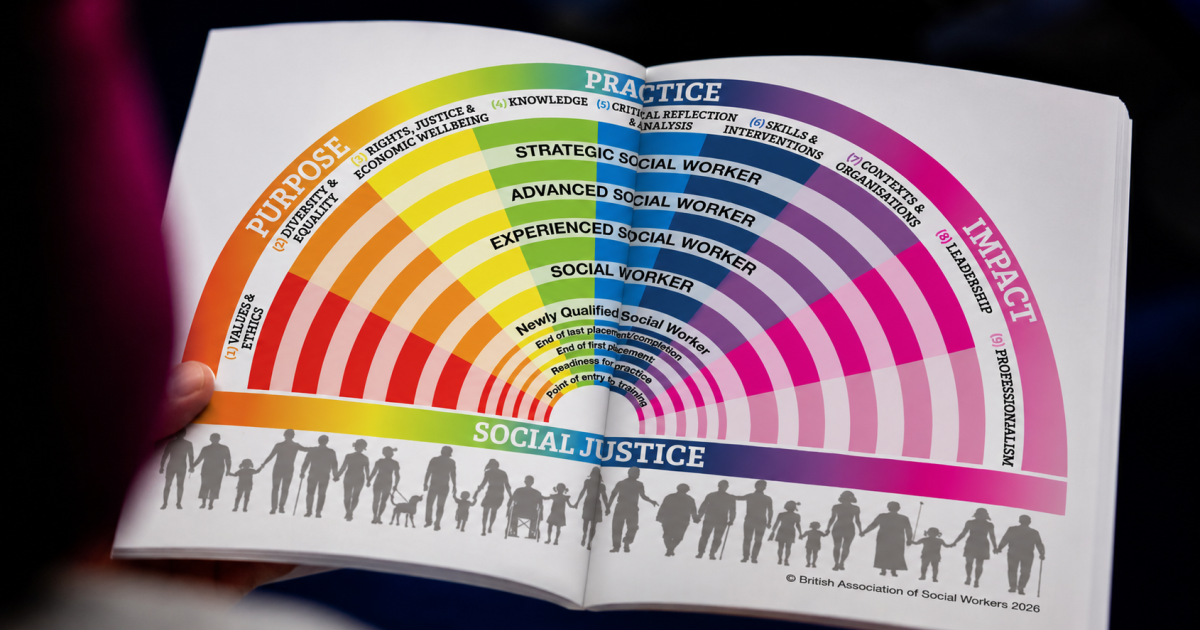
a. Understand the domains, super domains, and the underpinning core of Social Justice
b. Look at different models that underpin social work to develop skills in the nine domains of practice
c. Provide tips and hints for tasks and activities that meet the PCF for the different levels of social work
Introduction
This learning pod is designed to help you understand the new PCF. But I am hoping it will do more than that. By exploring the guiding principle of social justice that has become prominent in the framework, I hope to guide you through a basic understanding of ecological systems theory, first framed by Bronfenbrenner in 1979 and still informing anti-discriminatory and ethical practice today (see Crawford, 2020). I offer some hints and tips to help you prepare for placement. I discuss the different models that have become important for anti-discriminatory and social justice practice, including intersectionality (Crenshaw, 1989, updated text in 2013) and Contextual Safeguarding (Firming, 2017). Taker a listen to the PowerPoint below to find our more.
Five key takeaways:
- The refreshed framework grounds social justice as a non-negotiable framework for examining practice (see Rashid and Rashid, 2015)
- The new super-domains are
Purpose – Goes straight to values, ethics, diversity, equality, rights and economic wellbeing to promote social justice.
Practice – Grounds practitioners in social work knowledge, skills and interventions within critically reflective practice to work effectively in contexts and organisations.
Impact – Works with integrity and professionalism, becoming leaders, mentors and knowledgeable researchers to progress sustainable social work that impacts on systems.
3. Supports co-production and co-participation with those who access services and who have lived experience.
4. Puts social knowledge central in professionalism and contextual work in systems and in organisations.
5. Guides progression from student placement to strategic practitioner in leadership and mentorship roles.
What is the Professional Capabilities Framework?
The profession created the PCF, and it has been a mainstay of education and practice since the Social Work Reform Board developed it in 2010. It should follow you from your first placement through the different levels to strategic social work.
As a regulated profession, we must adhere to the Social Work England Professional Standards to maintain our title as a social worker. The PCF can guide us through practice as it is also mapped to the standards, which is why I think it is important to refer to it alongside the British Association of Social Workers Codes of Ethics and Practice throughout our careers.
The PCF helps social workers recognise the complexities of their role and the part they can play in shifting attitudes, challenging discrimination, and making a lasting impact on people, communities of practice, and sustainability.
Social work has always been committed to social justice, human rights, and respect for diversity, and the new PCF emphasises these principles. The refreshed framework reminds us of practitioners' collective responsibility to help ensure individuals are treated fairly and with dignity.
Practising with empathy and kindness can be difficult when we consider all the competing demands of the social work role. In the UK, I think our work can also become narrowly focused on the procedures and bureaucracy involved in assessment. These are important activities for social workers, but the underpinning philosophy of social justice can be lost without an eye to social work knowledge, guidance and theory. That’s why placements help social workers connect practice with learning.
The Placement Journey
Starting a placement can feel exciting and overwhelming. There’s a great deal to understand about how to apply everything you are learning into real-world practice. The standards, requirements, and ethical principles are interconnected, and tools such as reflection and supervision are spaces for skills development and critical thinking. Remember that, among all those competing demands, simple but powerful commitments lie at its heart: supporting people, promoting social justice, and helping to create positive change in people's lives.
To help with some of the overwhelming feelings in placement, the learning pod includes helpful hints and tips for identifying tasks that support your learning in the domains identified in the PCF. Placement provides invaluable opportunities to develop the practical skills required for professional practice. Activities such as assessments, casework, reviews, direct work with individuals and families, and multi-agency collaboration contribute to professional growth by strengthening capabilities and demonstrating professional standards.
Social Justice
The PCF is grounded in human rights, respect for diversity, and collective responsibility for targeted purpose, practice and impact. It has renewed the already ongoing commitment to social justice by making it a prominent feature of the framework. These principles influence practitioners' decisions and help ensure individuals are treated with dignity and fairness.
Global and universal social work
Social workers draw on knowledge from social sciences, as well as diverse cultural and indigenous perspectives, to understand the experiences and needs of the people they support. Doing so involves recognising the Global and universal nature of our profession and seeking a better understanding of sustainable social work. I provide some thoughts about these points in the Learning Pod. It’s essential to see the bigger picture and remind ourselves how our communities, ethnicity, gender, sexual orientation, and differing abilities shape the wider world. It’s also useful to know who we are within it all.
Critical Reflection
Developing not just reflection but critical reflection and critical thinking help us examine experiences by questioning assumptions and evaluating decisions. Critical reflection is not easy because it involves a more complex understanding of anti-oppressive, ethical and person-centred reasoning. How do we develop social empathy within the context of disadvantage that we work with in our everyday practice? There are lots of reflection models to help you examine practice. As you develop into a more strategic role, you should advance your reflective skills. Use supervision and reflective spaces to question assumptions and be curious about your practice.
Resources




https://www.thesocialworkgraduate.com/post/systems-theory
Crawford, M., 2020. Ecological systems theory: Exploring the development of the theoretical framework as conceived by Bronfenbrenner. Journal of Public Health Issues and Practices, 4(2).
Crenshaw, K., 2013. Demarginalizing the intersection of race and sex: A black feminist critique of antidiscrimination doctrine, feminist theory and antiracist politics. In Feminist legal theories (pp. 23-51). Routledge.
Crenshaw, K., 2022. Demarginalizing the intersection of race and sex: A black feminist critique of antidiscrimination doctrine, feminist theory and antiracist politics [1989]. Contemporary sociological theory, 1(354), p.0.
Firmin, C., 2020. Contextual safeguarding and child protection: Rewriting the rules. Taylor & Francis.
Rasheed, S.M.N. and Rasheed, J.M., 2015. Multicultural social work practice: A competency-based approach to diversity and social justice. John Wiley & Sons.